
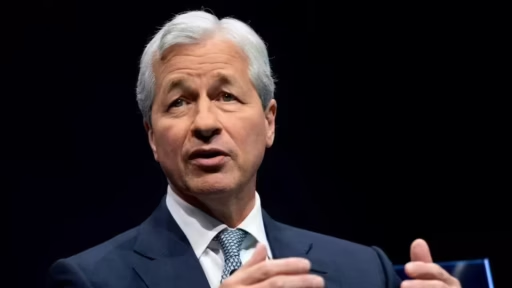


Jamie Dimon vs Remote Work: Why the Debate Is Heating Up Again
The future of work is still one of the biggest questions facing companies today. While many employees have embraced remote and hybrid setups, some corporate leaders are pushing hard in the opposite direction.
One of the most outspoken voices is Jamie Dimon, the CEO of JPMorgan Chase.
His message is clear and direct: companies that rely too much on remote work risk falling behind.
So why is he so strongly against it—and why do so many workers disagree?
Let’s break it down.
Jamie Dimon’s Strong Stance on Remote Work
“We Would Crush You”
In a recent interview, Dimon didn’t hold back.
He argued that companies built around in-person work would outperform those relying heavily on remote setups. His reasoning is simple—he believes being physically present creates stronger, faster, and more effective organizations.
It’s not just talk either. JPMorgan has already acted on this belief.
A Full Return to the Office
Starting in 2025, JPMorgan brought back a five-day, in-office work policy for most employees.
They’re not alone.
Major companies like Amazon and Google have also been scaling back remote work policies introduced during the pandemic.
This signals a broader shift among big corporations toward rebuilding office culture.
Why Dimon Thinks Offices Still Matter
The “Apprenticeship” Model
Dimon describes the workplace as more than just a place to get tasks done.
He calls it an “apprenticeship system”—a space where employees learn by observing, interacting, and collaborating in real time.
According to him, being physically present helps workers:
- Build emotional intelligence
- Learn from senior colleagues
- Receive mentorship and feedback
- Develop stronger professional relationships
These are things he believes are difficult to replicate over video calls.
Impact on Younger Employees
One of Dimon’s biggest concerns is how remote work affects early-career professionals.
Without regular face-to-face interaction, younger employees may miss out on:
- Learning opportunities
- Career guidance
- Networking within the company
From his perspective, this could slow down both individual growth and overall company performance.
What Workers Actually Want
A Very Different Preference
While executives push for office returns, employees are sending a different message.
Recent surveys show:
- 52% of workers prefer hybrid work
- 26% want fully remote jobs
- Only 21% prefer being fully in-office
This highlights a clear disconnect between leadership and workforce expectations.
Remote Work Has Its Benefits
Studies suggest that remote work can offer real advantages.
Some findings include:
- Higher employee engagement in certain roles
- Increased flexibility and work-life balance
- In some cases, higher earnings
Research has even shown that remote workers can earn more on average, often due to senior roles and location flexibility.
For many employees, remote work isn’t just a perk—it’s become a key factor in job satisfaction.
Dimon’s More Balanced Take
Not Completely Against Remote Work
Despite his strong comments, Dimon’s position isn’t entirely rigid.
He acknowledges that remote work can be effective in certain situations.
At JPMorgan:
- Around 10% of employees still work remotely
- Virtual teams operate in areas like customer service
- Flexibility exists for caregivers and specific roles
“It Depends on the Job”
Dimon’s main argument is that remote work is not a one-size-fits-all solution.
He supports it where it makes sense—but opposes it when it harms productivity, collaboration, or client service.
This more nuanced view often gets overshadowed by his stronger statements.
The Bigger Conflict: Companies vs Employees
A Growing Divide
What we’re seeing now is a clear clash between two priorities:
- Companies want productivity, collaboration, and control
- Employees want flexibility, balance, and autonomy
Both sides have valid arguments—but they don’t always align.
The Risk for Companies
If companies push too hard for full office returns, they may face:
- Higher employee turnover
- Difficulty attracting talent
- Lower morale
In today’s job market, flexibility is a major competitive advantage.
The Risk for Employees
On the flip side, fully remote work may come with trade-offs:
- Fewer opportunities for mentorship
- Slower career progression
- Weaker team connections
These risks are especially relevant for younger workers or those early in their careers.
What This Means for the Future of Work
No Single Answer
The reality is that there’s no universal solution.
Different industries, roles, and companies require different approaches.
For example:
- Tech companies may lean more toward remote work
- Finance and banking may favor in-person collaboration
- Creative roles may benefit from hybrid models
Hybrid May Be the Middle Ground
For many organizations, hybrid work is emerging as the compromise.
It offers:
- Flexibility for employees
- Collaboration time in the office
- A balance between independence and teamwork
This model may not satisfy everyone, but it’s becoming the most widely accepted approach.
Final Thoughts
Jamie Dimon’s strong stance on remote work has reignited an ongoing debate that’s far from settled.
On one side, leaders believe in the power of in-person collaboration and structured workplaces. On the other, employees are pushing for flexibility and control over how they work.
The truth likely lies somewhere in between.
As companies continue to experiment and adapt, the future of work will not be defined by one model—but by a mix of approaches shaped by business needs and employee expectations.
One thing is certain: this conversation isn’t going away anytime soon.